
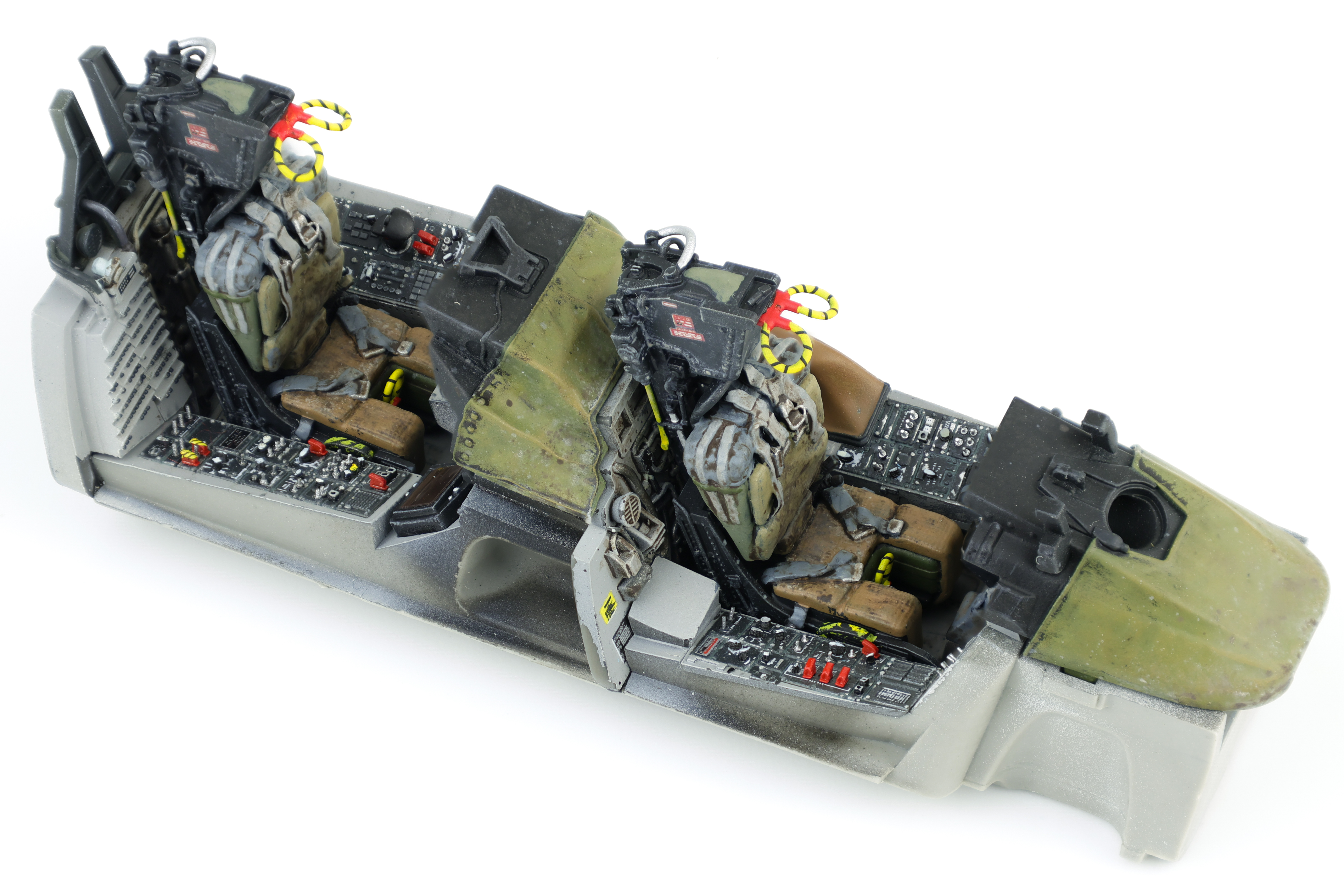
Tamiya’s F-14 has been on my Wishlist for some time now and only recently have I gotten the chance to build it. I decided to go all out for this build and opted to pickup a load of aftermarket for this project.

Like all aircraft, construction started with the cockpit. The Eduard set is very well detailed and a definite upgrade over the already fantastic stock cockpit. I also chose to include Master Craft Collection (MCC) 3d printed seats as the Eduard set does not include the later model GRU. 7A ejection seats. Work started by drilling out the side consoles in preparation of adding Anyz switches and dials. I’ve found that adding decals over top the molded on switches is difficult and I preferred to remove the all together.


Unlike my Phantom project, the addition of the resin cockpit meant that I needed to complete no scratchbuilding work. This was a welcome change and it meant that work quickly progressed to the painting phase.

After a coat of black primer and a silver chipping coat+hairspray, I applied Tamiya Sky grey for the majority of the cockpit with the side panels emphasized with Nato black. I then did some cockpit chipping by soaking the cockpit in water before rubbing a stiff brush over the areas where I wanted wear to accumulate. On my recent Phantom project, I chose to use sponge chipping instead of the hairspray method and I wasn’t super pleased with the results I managed to achieve. I found that using the Hairspray method here was far better and got the result I was after. That said, It was still important not to overdo this effect, especially on the side consoles as the chips were particularly visible.


I then moved on to working on the front and rear instrument panels. These were somewhat less straightforward than the cockpit tubs as the paintwork required for them required some delicate masking. As indicated by the instructions and reference photos the instruments themselves were painted black with the panel itself finished in grey. I chose to try out a new technique for painting the instrument panels and I opted to first paint them black, followed by hairspray chipping, with grey following over top.

This would allow me to use the raised detail of the instruments to chip off the grey, revealing the black underneath. I think this approach worked ok, although there is some definite improvement to be found. I finished the panels with a medium grey drybrushing to highlight details.

With the paintwork completed, I then moved on decals. I chose to use decals from Anyz and Jira-Gio to placard the side and instrument panels. This really helps to bring the cockpit alive and is a really key step in finishing the cockpit. After the decals dried, I applied a grey wash in-between the panels and a dark brown wash on the cockpit floor. After sealing the cockpit in a matt varnish, I decided that I wanted to try something new when it came to the main displays. I chose to use photography film to recreate the displays as they provide a really nice reflective finish.


Next up, I decided to work on the ejection seats. These were 3d printed from MCC and are very well detailed. After a primer coat of Mr. Surfacer 1500 black followed by a layer of Tamiya Nato Black, I got to work brush painting all the various elements of the ejection seat. This meant painting the seat cushions/belts in the appropriate browns and greens, along with the various wires and cables attached to the seat.


Weathering the seat was done with oils to recreate years of staining and discolouration on the seat cushions. I chose two shades of oils, a dark brown shade and a lighter dust colour. I first flicked on each of the two colours before blending them with oil paint thinner. This helped to create random shapes and intensities of both colours and really helps to achieve a weathered look in the fabric which is what I was looking for. I utilized this same technique for the fabric coverings behind the instrument panels as I wanted to recreate what the fabric looked like after sitting in the sun for some time.


With the completion of the ejection seats, the cockpit on the F-14 was more or less completed. I added the Anyz swtiches along with the required cockpit parts (Control sticks and throttle). I was really quite happy with the end result here and I think it was a definite improvement over my previous Phantom cockpit. Next up: the Gear bay!


Leave a Reply