Tag: 1:48

  • F6F-5 Hellcat: Painting and Decals

    F6F-5 Hellcat: Painting and Decals

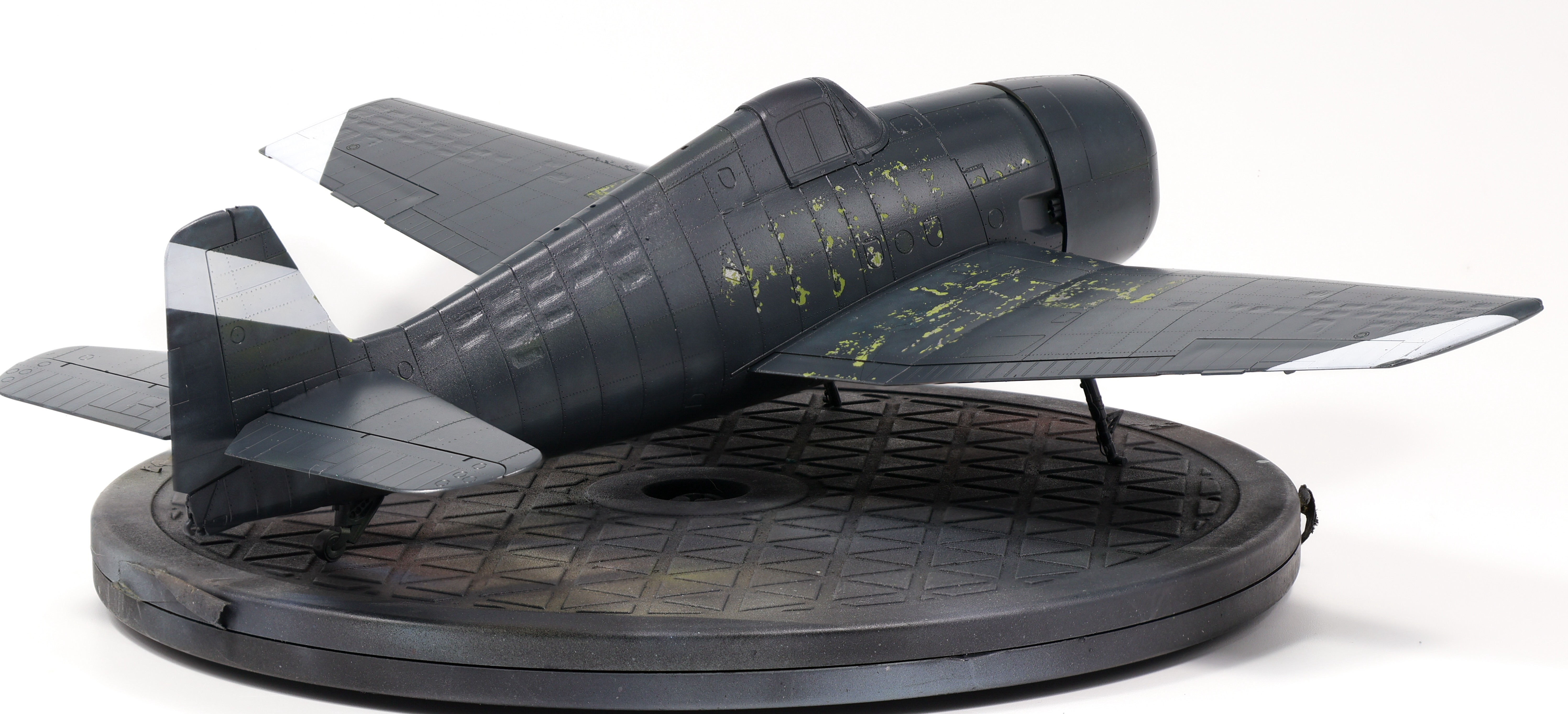
    For the past few weeks I’ve been steadily building Eduard’s 1/48 F6F-5 Hellcat as a sort of “reset” build to complete before diving into the painting stage of the Tiger project. I picked the Hellcat because I’ve always had a soft spot for U.S Navy fighters and also because I wanted to move this kit out of the stash.

    Construction was straightforward although a bit disappointing. This kit is by no means a new Eduard release with the molds dating back to 2008. This is not that ancient but in the grand scheme of things it’s a far cry from the hyper detail kits the brand is releasing nowadays. If you’d like to hear more about my thoughts on this kit, I did a out of box review on it last year:

    Eduard F6F-5 Hellcat (Late) In Box Review

    Eduard’s Profipack Hellcat has impressive features including photo-etched parts, resin wheels, mask set, and armament options. However, its quality of molding is below-par as it lacks detail and crispness. Eduard’s excellent instructions and various marking options are commendable, albeit limited in color and vibrant prints. With a challenging price, the kit’s weekend edition provides better…

    The chipping effects on this build required a two stage chipping process. The first stage consisted of a metallic colour underneath a custom zinc chromate mix chipped with standard hairspray chipping. This was done somewhat quickly as the results didn’t matter too much in that only a small fraction of this coat would be visible in the final model. After this coat was chipped, I hit it with a coat of hairspray and re-primed with 1500 black for the preshading coat.

    The preshade/marble coat took an entire day to complete and I was very happy with how it came out in the end. I was able to get a lot of variability in the finish which I knew would be needed to show through the very dark blue final coat.

    For the main coat I selected Mr. Colour 14 (Navy Blue). It’s a semi gloss paint to start and I added some GX100 gloss to increase the sheen which worked well I found. I knew that I’d be finishing this model in a gloss finish and wanted to make sure that my base coat was as smooth as possible.

    I then got to work removing the masking fluid left behind as part of the weathering process and I was really happy with how this approach turned out. It was difficult at first to remove the fluid but with a plastic tool I was able to scrape it off quite efficiently. I was worried about paint peeling off in areas where the fluid was not applied but this ended up not being an issue as the main coat of Navy Blue was very durable.

    After removing the masking fluid I hit the model with a coat of GX100 gloss varnish in anticipation of the decals.

    Decals were out of the box, and went down somewhat well. Being from Eduard, I decided to experiment with removing the carrier film with Tamiya Enamel thinner. This went well and helped achieve an even greater painted on effect.

  • CF-18A: Decals and Weathering

    CF-18A: Decals and Weathering

    After the paint was down, it was time to clear coat. I’m always on the hunt for a better product or method for sealing a model as it’s my least favourite part of model building. I find that adding a gloss coat is the step I always have the least control over and it has the most ability to fuck up all the hard work I’ve put in the model, I learnt this the hard way when I built my Mp4/13 a few years back:

    What happens when you put a Laquer clear coat over Enamel paint.

    As such, I’ve always tended to choose a “low risk, low reward” method for clear coating. For the longest time that was Tamiya clear + Mr. Color levelling thinner (MCLT) as it was always a pretty safe way to get a clear coat on the model and didn’t take too much thinking beforehand. I switched to VMS clear a little while ago as the application was even more simple, just drown your model in it and it’ll shrink down into all the panel lines no problem. For a while VMS was my go to but I found it wasn’t the most chemically stable, it frosted very badly over a week-old layer of paint and nearly ruined a Spitfire I was working on:

    Had to remove paint in some areas down the primer, I was luckily able to salvage the build.

    As a result I switched back to Tamiya clear but still wasn’t quite happy with the results I was getting out of it. I found that I wasn’t able to get as smooth surfaces as I’d like with it. I then discovered Mr. Hobby GX 100 Super clear III. GX 100 is to other clears as what MCLT is to other thinners, the stuff is absolutely fantastic in so many ways. Easy to apply, durable, chemically neutral, and most of all a fantastically smooth surface.

    I shot a layer of 50/50 Gx100/MCLT then misted straight MCLT over the still drying first layer. This technique can be a bit difficult to achieve but basically you want to spray the straight MCLT on the model until the very point in which the surface becomes “wet”. You want to avoid drenching the model because you are spraying straight thinner onto the finish and can burn through the paint if you’re not careful, this is a very “hot” method of painting. The end result looked a little semi-gloss rather than gloss in the final result but it was still the smoothest (in terms of feel) finish I’ve ever had, which is what really matters for the decals.

    Speaking of decals, I used the “Combat Hornets” set by a local company, Leading Edge Models. If you want to depict a combat Cf-18, this is the set to get. You get options from the early 90’s to present day and enough stencils to build two jets. It includes specific markings for almost two dozen aircraft and the ability to depict any Cf-18 with the assorted numbering (which is what I did) They are durable and settled down excellently there is no competition in this category right now, These are the best Cf-18 markings out there right now hands down.

    Oil paints, as always, were used entirely for the weathering process. I first hit the model with a mixture of very dark brown and dark grey oil wash. This mixture had the intended effect of not being super noticeable over the grey finish, which is typically desired for more modern aircraft finishes. I sealed the initial wash with VMS Satin before moving on more detailed oil work. I used Abteilung Bitume oil paint in this stage, it’s by far my favourite oil shade to work with. I taped off where I didn’t want the oil effect to appear and stippled the paint in order to get a smooth transition.

    I like to use this tactic because it’s so versatile IMO. If you want only a very subtle effect you can load your brush up with thinner and blot out 95% of the paint. On the other side you can leave most of it and it’ll create a very striking contrast. After that I also did some various streaking effects on the wing. This is a common effect to create for Cf-18’s as the streaking fluid is typically very visible in a lot of reference photos. I hit the model with a coat of VMS Matte and the weathering stage was complete!

  • CF-18A Hornet: Main construction and Painting

    CF-18A Hornet: Main construction and Painting

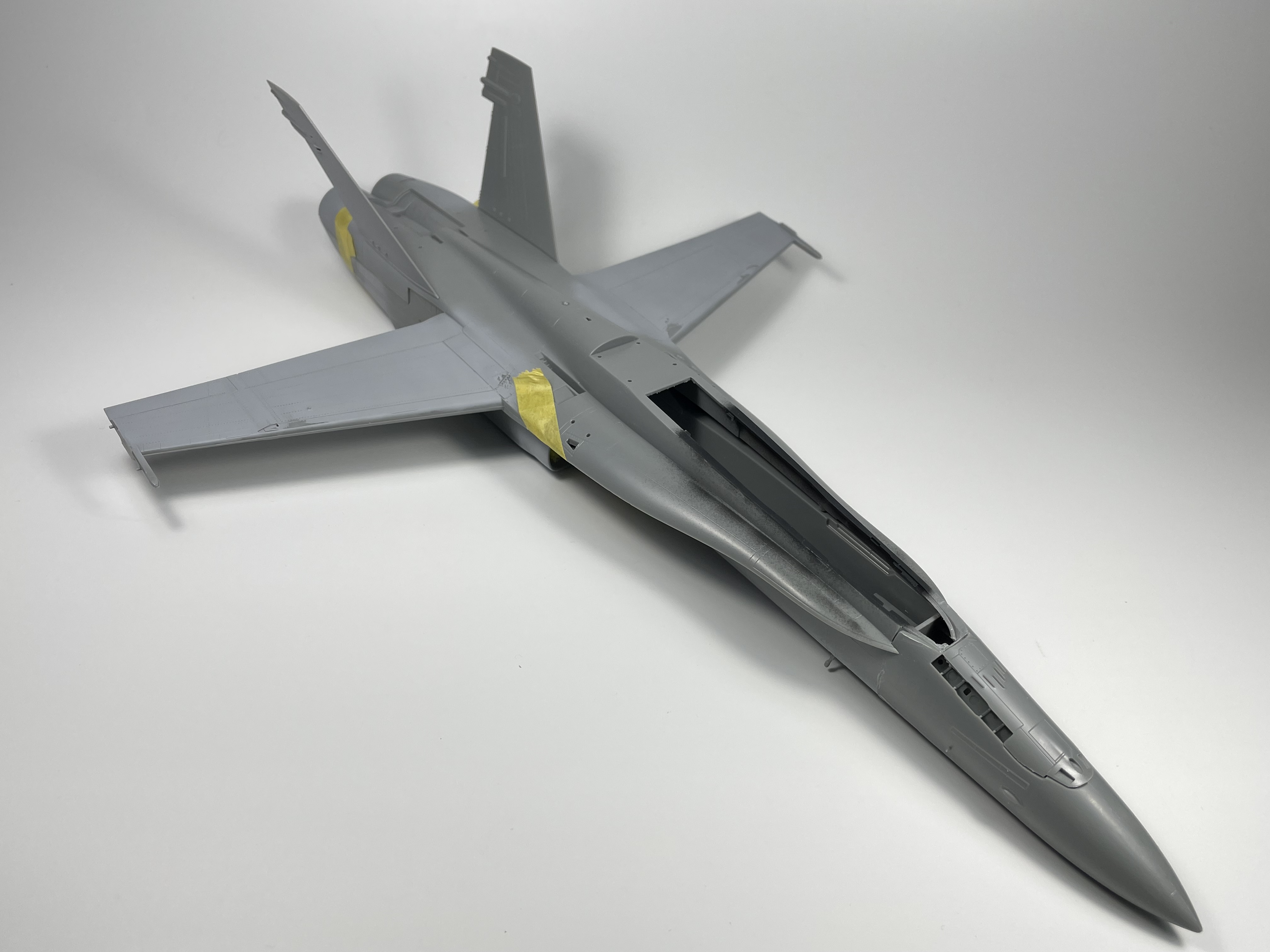
    With the cockpit and gear bays completed, work could get started joining the two fuselage halves and other assemblies before spraying paint. I have to admit, I wasn’t looking forward to this part as Kinetic’s nose assembly is rather infamous for it’s fit and this build is no exception.

    The whole nose and front windshield assembly is such a bear to build, It’s really quite frustrating that they built it the way that they did. none the less I was able to complete it after a lot of sanding and swearing and got it to a place where I was reasonably happy with it.

    almost ready for paint!

    Seeing as I’m opting to represent a early 1990’s Hornet, I also removed the nose antenna and opted for the early style antennas on the spine of the aircraft. Mr. Finishing surfacer black was the primer of choice (my default choice) and I got to work on the main painting process.

    I also started with the main painting process by marbling the control surfaces. They are all being painted separately and I typically use them as a test bed for practicing before committing to the main body. I chose three main shades for the marbling xf-23 light blue and xf-65 field grey were used as the grey and green shades along with a mix of xf-10 flat brown and xf-57 buff for a brown shade. Both the xf-23 and xf-65 were lightened with white before applying them to the model. It’s important to lighten the marble colours before applying them in my opinion as if they are took dark then it is difficult to get coverage with the main coats and as a result the main coat must be a shade lighter. By preshading and marbling with a slightly lighter shade you can avoid this and spray the exact desired final colour.

    For the first blend layer I used Mr. Color 308 (FS36375) and 337 (35237) for the lower and upper surfaces respectively. I sprayed a very thinned mixture as I really didn’t want to overpower the pre-shading/marbling. After blending the finish I sprayed Tamiya flat white through a torn up scour pad to get some surface highlights and additional variability. The end result set me up quite nicely for the final coats of paint.

    After unifying the surface I was left with the finish below. I’m quite happy with how this main round of painting has gone although I do want to go a bit further with various post shading effects. This was my first Cf-18 and all in all this was the overall effect I was searching for.

  • CF-18A Hornet: Cockpit and Gear bays

    CF-18A Hornet: Cockpit and Gear bays

    For my next major project I decided on building a CF-18 Hornet, I’ve always wanted to build one and really wanted to utilize everything I’ve learned over the past year.

    After doing some research on the available options, I settled on the 1/48 offering from Kinetic. The brand wasn’t my first choice, but they are the only manufacturer that has a somewhat new mold of a legacy Hornet.

    I wanted to do a somewhat fresh take on this subject and so opted to build an early 90’s bird that participated in the 1991 Gulf War and in the scheme prior to the distinctive “Canada” wordmark (fellow Canadians will know what I’m talking about this logo is everywhere).

    A CF-18 sits on the ramp in Doha, Qatar as part of “Operation Friction”

    Construction unsurprisingly starts with the cockpit. I took my time here, spending a few extra days to get all the details I wanted added. Lots of extra wiring was added to the resin Aires seat and the end result really paid off. Lead and copper wire was used (0.1, 0.2 widths ) along with brass micro-tubes from Albion alloys. Some 3d Printed avionics from Anyz were also used. I coiled 0.1mm copper wire to create a avionics cable in roughly the same position it is in real life.

    The cockpit was painted over a few days, It was surprisingly straightforward. After adding the X-22 clear coat, the real fun could begin, dealing the cockpit. For this I used Anyz and Airscale decals. Anyz makes really great “miscellaneous” decals and cockpit switch selector indicators. Airscale has good warning and dial decals.

    Overall I’m very happy with how the decaling went for this project, it’s time consuming work, but not difficult by any means

    For the weathering, I wanted to keep it restrained but obvious that the jet was working in a desert environment. I felt that it would be reasonable for dust to accumulate in areas of the cockpit. The key would be to keep it very subtle. I used dusty shades of oils to brighten up the surface and pickout highlights.

    Kinetic’s gear bays are quire well detailed OOB. None the less, I still wanted to add some extra detail here for the experience. After looking at various reference photos I could tell that they were incredibly busy and complicated, and the extra piping would help increase the realism. I found it difficult to work in the nose gear wheel well as there really isn’t a lot of space to work in. As such, most of my detailing efforts went into the main gear bay. I painted the bays in standard Tamiya white and picked out details with various metal shades along with Tamiya black.

    I added various Anyz and Airscale decals to the wheel wells and I feel that having lots of placards in the area really adds to the realism. For the weathering I think that I may have overdone it in same regards. I first did a very light brown (tan coloured really) oil wash in order to simulate dust buildup. I then followed that up with a very dark brown/black pinwash in crevices to pickout all the details. I then spreckled the surface with MIG’s oil and grime effect to simulate oil spots. Is it overdone? yup, that’s ok though it not too off the mark IMO but this result is on the dirtier end of the spectrum for sure.

    To return to the cockpit, all that was left to complete on it was to add the sidewalls and Anyz dials to the build. Suffice to say I’m very happy with how the cockpit turned out.

  • Tamiya Bf-109 G-6 In Box Review

    Tamiya Bf-109 G-6 In Box Review

    Kit Features: 15/20

    Tamiya’s 2017 G-6 is an excellent baseline as to what we as modellers should be expecting in 2023. Tamiya includes a well-stocked kit that is as equally perfect for a new builder as is for someone experienced in the hobby. The only features missing from this kit would be photo-etched parts or possibly resin inclusions as found in Eduard Profipack releases. What is included is a full DB 605 engine that can be built displayed or not (and crucially changed after completion between the two), a pilot figure, canopy masks and various other variant-specific options for building. In my opinion the inclusion of the masks and engine are significant, masking canopies for me is one of the more tedious parts of the hobby and I welcome the inclusions. Many kit builders will “include” an engine in so far that since the engine will be visible when completed, so something has to be there to take up space. Tamiya’s offering is the real thing. Kit features are rated as a 15/20, Tamiya includes a lot and there really isn’t much missing here.

    Quality of Molding: 34/50

    Tamiya’s new tool kits really are quite special, and the molding is an example of why. panel lines are very clear and the kit is the definition of “crisp” no flash is present at all. The only points that Tamiya looses out on is the fact that there are some rivet details missing that will need to be added if the modeller desires. As a counterpoint, Eduard is able to include all of the rivet details in their new tool Bf-109’s. Tamiya losses more points due to the fact that ejector pin marks are visible in prominent locations in the cockpit that will need to be filled. None the less, this 109 will build up to an excellent looking model and has a level of detail where I’m looking forward to getting a wash down into the surface details.

    Instructions: 14/20

    The instructions are perfectly workable and do offer some comforts to the builder. They are unfortunately not in colour and printed on cheaper materials but this downside is mitigated by the fact that the important colour profiles are in full colour and blow up much larger. I do wish that Tamiya included more information about the subject rather than the standard: “9/JG54, February 1945” It feels lacking compared to what Eduard is doing in this space in regards to the historical background of the subject. Despite these shortcomings the Tamiya instructions really are quite clear in what the modeller is required to do in each step with important parts clearly labeled.

    Miscellaneous: 6/10

    The kit includes 3 options for markings although it could be said that there is really only one option, the standard “grey 109”. I wish Tamiya included at least one other interesting option as G-6 109’s did come in several other schemes. The decals are perfectly printed and very clear, especially with the bright colours, no points lost here. The markings overall are a bit meh, you could say they’ve done a good job with mediocre subjects. As a final point I am docking them a score due to the fact that they use staples to seal the parts bags which can damage sprues unless completely removed, something a new builder might not realize.

    Total: 69/100

    Tamiya’s G-6 is a great kit, although this score may be deceptivley low the fact is, part of the “Tamiya Tax” is the fact that the modeller pays for the the engineering and fit of a Tamiya kit (and the brand!) and not necessarily the detail or what’s inside the box. In contrast to my previous reviews it may seem that this kit is only marginally better than Eduard’s Hellcat or Tamiya’s 20 year old Mosquito, and to be fair that’s not far off the mark here, but it’s an objective fact that this G-6 is a great kit when competitively priced between 60$-70$ CAD.